Friday, October 24, 2014

Women Make Tough Choices When it Comes to Family and Wellness


Working mothers make difficult trade offs when it comes to career and family. While trying to pursue career aspirations, mothers often try to balance the responsibilities of being a parent.  

Workplace policies aren't always supportive of a healthy balance between the two. Inflexible work arrangements mean mothers make hard choices when it comes to taking care of a sick child or earning a paycheck. 

A recent poll by the Kaiser Family Foundation, a nonpartisan think tank, sheds light on some of these trade offs that working women (now comprising about half of the US workforce) must make.

In the majority of households across the country, women manage health care decisions for the family. Roughly three out of every four women decide on a doctor, take children to appointments, and then execute a health provider's recommendations on care.  

When doing these things though, many women take time off from work. And 60 percent of women who take time off are not compensated.


Such inflexibility has a number of ripple effects:

1. Women lose out on valuable pay, which is already not on par with their male counterparts.

2. Seeking health care turns into a last resort. Out of fear of losing pay, women may opt to forgo seeking heath services for a child.

3. Decisions related to health and illness are major sources of stress by themselves. Work challenges and trade offs only add to this stress.

The good news is that more employers are thinking about employee wellness. Organization policies and culture, however, don't always find their way into these conversations. If wellness is indeed a priority, we need to think about the ecosystem of factors that influence our entire physical, mental, emotional and spiritual well-being.     

Wednesday, October 22, 2014

Tempo Progression Run on the Treadmill

I traveled to Tulsa, Oklahoma earlier this week for work and that meant only one thing: treadmill workout at the hotel gym. 

Whenever I'm able to, I like to run the same day I fly into a new city. Ideally I run outside, which is my way of seeing the sites and getting the blood in my legs recirculating. But, since daylight was running out after I arrived, I hit the hotel gym for a treadmill session. Just a few minutes after warming up my legs felt surprising fresh. I'm still in the early phases of getting back into training, so most of my workouts have just been whatever I feel like doing on that particular day.

I felt great on this particular day. On the fly, I came up with this progression tempo run. It will definitely find its way back into my training down the road.


---

(Everything at 1% incline)

20 minute warm up (build to about 30 seconds above lactate threshold, LT)

Alternate 5 minute work intervals and 5 minute recovery intervals as:
  • (4) Work Intervals: #1 @ marathon pace --> #4 @ 5k pace (decrease by ~10-15 seconds every other 5 minutes)
  • (4) Rest Intervals: #1- 45 seconds slower then work interval --> increase pace by same amount work intervals are decreased  

Wednesday, October 15, 2014

3 Focus Areas to Improve Biomechanics, Generate More Power, and Help You Run Faster

Biomechanics are a bit of a Pandora's box in the running community. Some say they're the ticket to getting faster and building endurance. Others think runners should just stick with what's comfortable and natural.

Regardless of which camp you fall into, there are a few fundamental aspects of running biomechanics that could influence running economy and performance, and certainly relate to injury prevention. Here are three areas to focus on if you're looking to improve your biomechanics, generate more power, and get faster.

1. Back Kick 

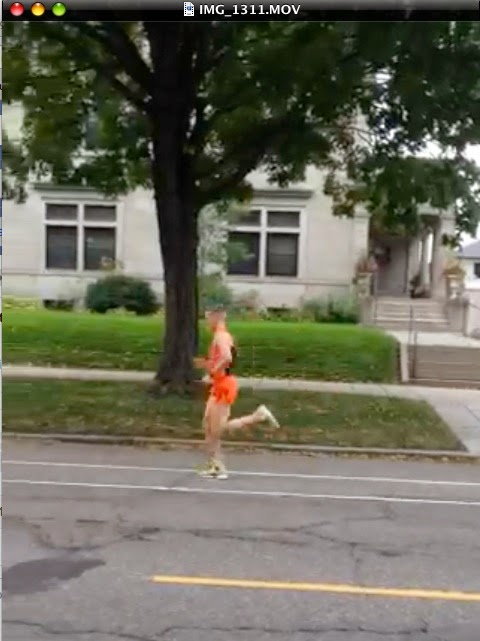
During the swing phase of the gait (when the foot is off the ground and moves from behind to in front of you), the foot acts like a pendulum. Your hip is the pivot point, and your leg and foot are "suspended" from the pivot point. When it comes to pendulums, there's one really important variable: the length between the pivot and whatever object is at the end of the pendulum. In this case, it's your foot. A shorter pendulum is faster (or in physics speak, oscillates with a smaller period). Applying this to running, from a biomechanical perspective, having a shorter leg pendulum would be most economical. How do you "shorten" the leg while running/walking? The back kick. In the picture below, you'll see how pronounced the back kick is in many elite runners (this one from the front group at this year's Twin Cities Marathon). The runner then actively brings the foot and leg forward through the gait by driving his knee. (One other thing to note: this is at mile 25!)


2. Knee Drive


As the right foot comes forward, the runner aggressively drives the knee upward and forward. This is where a lot of the runner's power comes from. But, he's only able to do this because of strong hip extensor muscles (muscles that are somewhat notorious for being weak in many runners). He engages his hip extensor muscles, and with a strong knee drive, also drives backwards with his left leg (the toe off part of the gait cycle). A pronounced knee drive also sets up the runner for an effective foot strike. See the next picture, particularly looking at the right leg/foot. The knee drive helps avoid excessive dorsiflexion of his foot. Dorsiflexion is when you point your toes upwards. Too much dorsiflexion usually sets a runner up for heal striking, while a more neutral position, such as in this picture, usually means a more mid-foot strike.


3. Foot Strike


Two big points on the foot strike. The first is that the runner strikes mostly at his mid-foot, which tends to generate less impact forces on the lower limb joints compared to heal striking. The second point is where the foot lands relative to the rest of the runner's body. It's almost directly under the runner's head and hips. In fact, you can basically draw a straight line from the top of the head, through the torso and hips, and finishing at the heal of the foot. Having this type of alignment, with the foot striking under the hips, enables the greatest amount of power to be generated.


By focusing on these three main factors over the past few years, I've seen some huge improvements in my own racing. For example, here's a side-by-side of what my "knee drive" looked like five years ago and what it is this year.

Take time to revisit the basics. Set a good foundation and the rest will follow.

Friday, October 10, 2014

The Secret to Making a Kick-Ass Salad You'll Actually Crave

I'm known as the salad guy. Every day, without fail, lunch is always a salad. Sometimes I'll go a few months eating more or less the same one. Other times, I'll vary things up. Either way, my salads are one of the most nutrient-dense meals I prepare. Especially during periods of heavy training, this is critical for getting a lot of the vitamins, minerals and nutrients I need to recovery properly. The high nutrient density is also why I'll actually start craving dark leafy greens and vegetables if I'm forced to go more than 36 hours without a salad (like if I'm traveling). Ask my wife, I can get pretty cranky.

So, what's the secret recipe?

Well, recipe might be too much of an exact word for my salads. I don't really measure things out, unless a handful of this, a shake of this, and a pinch of that is considered "measuring." Mostly, I just like to take a bunch of different vegetables, throw them in a big bowl, add some seasoning and fat, and dig in.

Here's how it goes:

Step 1: Start with a nice, large bowl, something that can fit at least six cups. But, don't be shy, I've used some of our largest mixing bowls for salads.


Step 2: Add in your favorite dark leafy green. This can be spinach, kale, romaine lettuce, arugula, chard, mustard greens, or some combination. Stick with organic when you can to reduce the chances of being exposed to pesticide residue.

Step 3: Chop 3-4 vegetables of your choosing: cucumber, bell peppers, tomatoes, radishes, really whatever looks good at the grocery store and you're in the mood for. The "organic rule" applies here too. Instead of chopping them, I use a peeler and shave pieces of carrot on top.


Step 4: Add an herb: parsley, cilantro, oregano. They add a nice flavor and many herbs, particularly parsley and cilantro, are great at helping to detoxify.

Step 5: Add some fat and protein. My one-two combo for this are avocado and sardines. I love sardines because they are low on the food chain, so you don't have the same heavy metal risk as larger fish, and they pack an amazing nutrient profile, particularly omega-3s. So, if you're a hard charging athlete, or just want to support a healthy nervous or immune system, these should be a go-to. One word of caution with sardines: be mindful of the brand you buy, particularly where the sardines are from and if the can is BPA-free (BPA is a known endocrine-disruptor, aka messes with your hormonal system, and has been linked to a number of health problems). A favorite brand of mine is Wild Planet.


Step 6: Add sea salt and pepper to taste. Because I follow a fairly low-carbohydrate diet, I find I need to add salt to a lot of my food to ensure my blood pressure doesn't get too low. I stick with himalayan sea salt when I can.

Step 7: Dress with extra-virgin olive oil (again preferably organic, cold-pressed, and packaged in a dark bottle to avoid too much sun/heat exposure, which can damage the delicate fats). I stay away from any commercial dressings since many are made with soybean or other vegetable oils. One brand I've found to be the exception is Tessemae's, which has olive oil-based dressings. I'm fairly liberal when it comes to the olive oil, since that, the avocado, and sardines are the largest sources of calories in the meal.

Step 8: Grab a fork and dig into your kick-ass salad!

Try one this weekend and let me know how it turns out! If you have a favorite version of your own kick-ass salad, share in the comments.

Monday, October 6, 2014

21 Inspiring Quotes from "The Obstacle is the Way" by Ryan Holiday to Turn Trials into Triumphs

If you haven't read this book yet, you should. Ryan Holiday deconstructs the basic, timeless principles behind stoic philosophy, first pioneered by thinkers like Seneca and Marcus Aurelius, into a practical guidebook for how to live life. Totally accessible and grounding, it's a book you'll likely go back to over and over again for inspiration. I have already.

Here are 21 of my favorite, inspiring quotes:

1. "You will come across obstacles in life - fair and unfair. And you will discover, time and time again, that what matters most is not what these obstacles are but how we see them, how we react to them, and whether we keep our composure. You will learn that this reaction determines how successful we will be in overcoming - or possibly thriving because of - them."

2. "Too often we react emotionally, get despondent, and lose our perspective. All that does is turn bad things into really bad things."

3. "...if we have our wits fully about us, we can step back and remember that situations, by themselves, cannot be good or bad. This is something - a judgement - that we, as human beings, bring to them with our perceptions."

4. "There is always a countermove..."

5. "We can't change the obstacles themselves - that part of the equation is set - but the power of perspective can change how the obstacles appear. How we approach, view, and contextualize an obstacle, and what we tell ourselves it means, determines how daunting and trying it will be to overcome."

6. "Where the head goes, the body follows."

7. "But every ounce of energy directed at things we can't actually influence is wasted - self-indulgent and self-destructive. So much power - ours, and other people's - is fritted away in this manner."

8. "Focus on the moment, not the monsters that may or may not be up ahead."

9. "When given an unfair task, some rightly see it as a chance to test what they're made of - to give it all they've got, knowing full well how difficult it will be to win. They see it as an opportunity because it is often in that desperate nothing-to-lose state that we are our most creative."

10. "No way around it: It's on you."

11. "...genius often really is just persistence in disguise."

12. "Stop looking for angels, and start looking for angles."

13. "Respect the craft and make something beautiful."

14. "How you do anything is how you can do everything."

15. "Just our best, that's it. Not the impossible. We must be willing to roll the dice and lose."

16. "True will is quiet humility, resilience, and flexibility; the other kind of will is weakness disguised by bluster and ambition."

17. "We protect our inner fortress so it may protect us."

18. "But there is always some good - even if only barely perceptible at first - contained within the bad. And we can find it and be cheerful because of it."

19. "Perseverance is something larger. It's the long game. It's about what happens not just in round one but in round two and every round after - and then the fight after that and the fight after that, until the end."

20. "Lend a hand to others. Be strong for them, and it will make you stronger."

21. "Behind mountains are more mountains...One does not overcome an obstacle to enter the land of no obstacles."